|
|
|
Program > Field Trips
Field trips
August 26 will be devoted to field visits, offering participants the opportunity to observe a wide range of restoration projects carried out in Brittany over recent years and decades.
These visits cover a variety of environments, from urban settings to coastal landscapes. Most excursions require suitable walking footwear (except visit no. 8, which takes place in an urban setting). Please note that some visits are full-day excursions, others are half-day, and the first two are extended full-day visits requiring an early morning departure. The programme remains subject to change (additions or cancellations may occur). Participants are asked to select three visits in order of preference, as places may be limited.
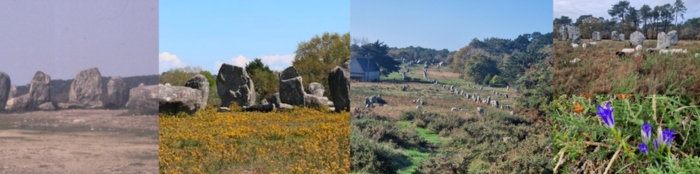
#1 – Carnac Megalithic Site and Quiberon Peninsula: Two Examples of Restoration of Over-Visited Sites in Morbihan (Full Day) The coastline and iconic Breton sites have been affected by overuse for several decades. Protective measures have therefore long been implemented to enable site restoration. Morbihan is particularly affected due to high tourist pressure. During this field trip, two contrasting sites will be visited:
Organized by the University of Brest, in collaboration with the Centre des Monuments Nationaux, Dunes Sauvages de Quiberon, and the Conservatoire du Littoral. This field trip is a full day with an early departure as it involves a long bus journey.
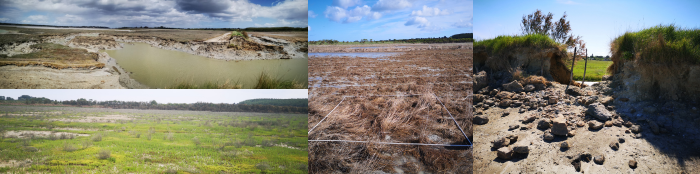
#2 – Restoration of coastal Ecosystem: Ploubalay Polder and the Two Capes (Full Day)
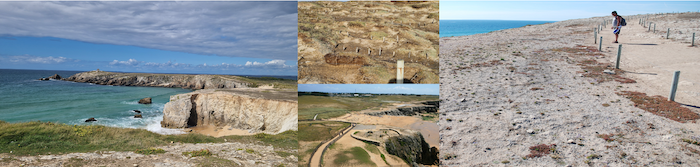
Due to the diversity of its ecosystems, the coastline of Brittany has been subjected to various types of pressure and degradation, including overuse, urbanisation and poldering. As a result, numerous restoration projects have been implemented over the past decades. Many of these have involved collaboration between researchers and natural area managers, reflecting the strong partnerships characteristic of Brittany. This field trip will explore a rich section of Brittany’s north coast, where a variety of restoration operations have taken place since the mid-1980s. Two types of restoration will be presented, linked to different contexts: 1/ Restoration of over-frequented cliff sites. Coastal cliff degradation is a major issue in Brittany, as capes are highly attractive due to their striking landscapes and panoramic sea views. In the “Two Capes” area, Cap d'Erquy and Cap Fréhel have experienced high visitor pressure and have undergone restoration, initiated in 1984 for the former and in the early 2000s for the latter (completed in 2019). 2/ Restoration of diked salt marshes (depoldering) Along the French Atlantic coast, many salt marshes were poldered during the last century, including both large polders (such as in the Mont-Saint-Michel Bay) and smaller ones (a few hectares). Many of these are no longer in use and offer strong restoration potential, as they no longer serve a protective function. The Ploubalay polder, which will be visited, was reconnected to the sea in 2020 through a process of accepted spontaneous depoldering under the ADAPTO LIFE programme, led by the Conservatoire du Littoral. Organized by the University of Brest, in collaboration with the Conservatoire du Littoral, Syndicat des Caps, and the Côtes d’Armor Department. This field trip is a full day with an early departure, as it involves a long bus journey
#3. Ouessant Island: Management and Restoration of Coastal Heathlandsand Grasslands (Full Day) The Armorique Regional Natural Park is the State-designated manager of the inhabited terrestrial parts of the Natura 2000 site "Ouessant-Molène." As such, it implements a management strategy aimed at maintaining and restoring habitats in good ecological condition. The visit will present management actions implemented on the island:
Organized by the Parc Naturel Régional d’Armorique in collaboration with the University of Brest and CEMO. For organizational reasons, the number of participants in this visit will be limited.
#4. Brest Bay: Management Aimed at Restoring Marine and Coastal Environments (Half Day) The Armorique Regional Natural Park is the State-designated manager of the Natura 2000 sites in Brest Bay. It implements a strategy aimed at restoring the marine environment. In partnership with various stakeholders, restoration work has been carried out in this largely marine area and will continue across different marine and coastal habitats. This field trip will provide an overview of ongoing projects in Brest Bay:
Organized by the Parc Naturel Régional d’Armorique, in collaboration with the University of Brest, IFREMER, the National Botanical Conservatory of Brest, and CRC North Brittany. For organizational reasons, the number of participants in this visit will be limited.
#5. Restoration of Peat Bogs and Moorlands by Filling in Drains (Half Day) Visit to peat bogs and moorlands restored as part of the LIFE Landes d'Armorique programme (2021-2025), using drain-filling techniques – methods used and initial results (piezometric monitoring). These environments were historically degraded by drainage ditches created to facilitate grazing and peat extraction. As these practices have now ceased, the Armorique Regional Natural Park aims to restore the ecological functions of these natural areas (biodiversity, water storage and purification, carbon storage). The restoration work consists of using excavation and backfilling techniques to completely or partially fill in the drainage ditches (using successive plugs), in order to maximise water retention on site. Over the duration of the LIFE project (2021–2025), approximately 5.5 km of ditches have been filled in, restoring an area of 54 hectares. Organized by the Parc Naturel Régional d’Armorique. For organizational reasons, the number of participants in this visit may be be limited.
#6. Restoration of Coastal Environments on the Crozon Peninsula (Full Day) The Crozon Peninsula, located to the south of Brest Bay, hosts a wide diversity of ecosystems, particularly coastal environments that have undergone significant changes due to visitor pressure, land abandonment, and marsh management. During this field trip, three main sites will be visited:
Organized by the Parc Naturel Régional d’Armorique, in collaboration with the University of Brest, the PCAM community of communes, and Iroise Marine Natural Park.
#7. Night-time Restoration in Brest and Surrounding Areas (Half Day)
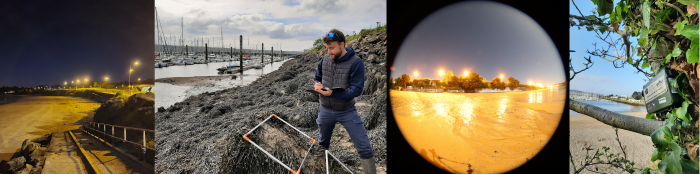
Light pollution is a major disturbance in urban, peri-urban and rural areas, directly and indirectly affecting organisms through disruption of circadian cycles and landscape fragmentation. Restoring night-time conditions by switching off public lighting or adapting lighting schedules can help re-establish favourable conditions for both nocturnal and diurnal species. Within the framework of the Interreg Darker Sky project, Brest Métropole implemented two restoration actions aimed at reducing the impact of artificial lighting. These sites (Moulin Blanc and Sainte-Anne) are located along the seafront, near relatively natural valleys that form the boundary of urban area. Surveys were conducted to assess both disturbance levels (light measurements) and impacts on biodiversity (birds, bats, arthropods, etc.). One of the sites also underwent soil renaturation. The visit will present lighting adaptation measures, as well as survey design and methods. Discussions with partners from the Armorique Regional Natural Park (PNRA) will provide a comparison between approaches implemented in urban and rural areas.
Organized by the University of Brest, in collaboration with Brest Metropole.
#8. Restoration of the Former Bodonnou Quarries (Half Day)
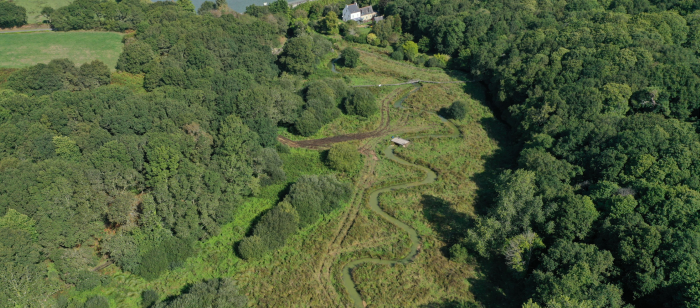
© Matthieu Le Gall The Bodonnou site, located in the municipalities of Plouzané, Guilers and Brest, was until the late 1970s an agro-natural area recognised for its ecological value (ZNIEFF of Kersquivit). From the 1980s, it was exploited for over 30 years for aggregate extraction. In May 2022, the operator transferred this 130-hectare site to Brest Métropole to enable its gradual redevelopment into an ecological area. Today, the site is gradually regaining a level of naturalness favourable to fauna and flora, with more than 650 animal and plant species recorded. A mosaic of habitats has developed, including ponds, reedbeds, moors, wet meadows, woodlands and scrubland. This remarkable natural area provides important ecological functions (resting, breeding and feeding areas for wildlife). Naturalist surveys carried out by expert organisations working with Brest Métropole—including the National Botanical Conservatory of Brest, Bretagne Vivante, GRETIA and the Breton Mammal Group (GMB)—confirm the site’s high biodiversity value at both local and departmental levels, particularly for birdlife. Organized by Brest Metropole, in collaboration with the National Botanical Conservatory of Brest, Bretagne Vivante, GRETIA and the GMB
#9. Wetland and Stream Restoration in South Finistère (Full Day)
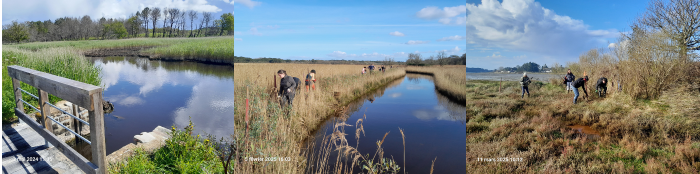
© Ouesco The first two sites, visited in the morning, will offer an insight into the typical restoration actions carried out by watershed managers in Brittany. The first project involves the removal of a pond located on a stream in order to restore the stream’s ecological continuity and its lateral connectivity with the surrounding wetland. The second site focuses on the remeandering of a small river to restore both river and riparian wetland functionality. The lunch break will take place at the Maison de la Baie d’Audierne, an emblematic site that plays a central role in the conservation of the coastal marshes, now included within the Baie d’Audierne Ramsar Site. In the afternoon, we will visit an ambitious restoration project involving both a wetland and a stream on the site of a former fish farm. The project required the removal of nearly 10,000 m³ of landfill material, the recreation of wetland soils following the excavation of the concrete fish ponds, the reprofiling of 180 m of river channel, and the installation of a new fish pass. The site, owned by the Departmental Council of Finistère, is now open to the public and managed through goat grazing. A short introductory presentation by the Loire-Bretagne Water Agency at the beginning of the day will provide an overview of wetland and river restoration policies and funding mechanisms in France. Organized by the Forum des Marais Atlantiques, in collaboration with Ouesco collectivity, the Finistère Department, and the Water Agency.
#10. Wetland and River Restoration in North Finistère Valleys (Full Day)
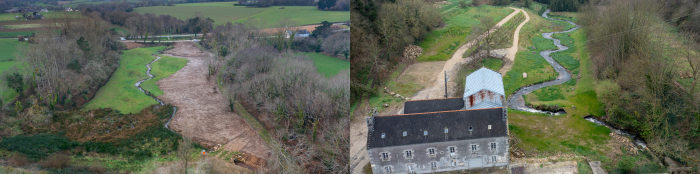
© Sky Art’s Production et An Dour This field trip will explore three restoration sites aimed at restoring valley-bottom functionality by reinstating rivers in their former beds and restoring associated wetlands. The first site (Moulin du Châtel) is located on the former site of a poultry farm that occupied the full width of the valley. The river had been buried under 4 metres of landfill on which the farm buildings were constructed. The project involved removing all buildings and landfill and restoring the natural valley-bottom profile, including wetlands and the river in its original course. If time permits, a smaller wetland restoration site—achieved through the removal of a former mill pond—will be visited on the way to the third site. The final site focuses on restoring ecological continuity of the Pontplaincoat River through ten restoration actions, two of which will be presented. This valley was affected by tin mining until the 1970s, leading to pond creation and displacement of the river from its natural bed. Restoration involved backfilling the excavated ponds to restore the valley profile and return the river to its original course. A brief introduction by the Loire-Bretagne Water Agency will present restoration policies and funding mechanisms in France. Organized by the Forum des Marais Atlantiques, in collaboration with SM Horn, and An Dour.
#11. Form Moorland to Peatland: restoration in the Cragou-Vergam Reserve (Full Day)
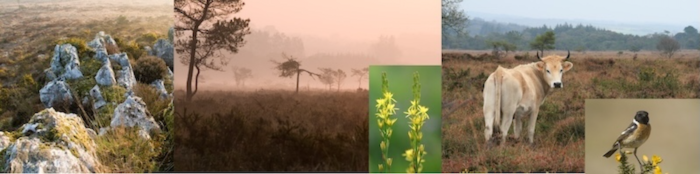
The Cragou-Vergam Regional Nature Reserve comprises wet heathlands and sloping peat bogs hosting exceptional biodiversity. Hen harriers and Montagu’s harriers share the skies with nightjars and Dartford warblers, while adders coexist with marsh fritillary butterflies and amphibious voles. The vegetation is also highly diverse, including several species of sphagnum moss, both species of sundew, and the rare marsh malaxis. Bretagne Vivante has managed this site for 40 years. To maintain these open habitats, grazing is carried out using Nantes cattle and Dartmoor ponies in wetter areas, while mowing by farmers and Bretagne Vivante helps maintain drier heathlands. In 2010, 27 hectares of Sitka spruce and Vancouver fir plantation were restored to heathland following clear-cutting. These areas now provide valuable habitats for birdlife, even if the heathland remains atypical. The day will include a tour of the reserve and its most emblematic landscapes, followed by a visit to the restored areas after a picnic break. Organized by Bretagne Vivante - RNR Cragou-Vergam
#12. The Ria d'Étel - Marshes restoration (Full Day)
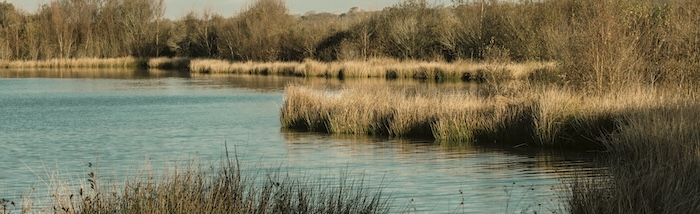
The Ria d'Étel, located in Morbihan, is a coastal estuary shaped by the inland penetration of the sea. It is particularly known for its salt marshes, which create distinctive landscapes between land and sea. These marshes host a wide range of wildlife, including birds, fish and specialised plant species. They also play a key ecological role in water filtration and coastal protection. The visit will focus on two main aspects:
Some marshes have been invaded by Baccharis halimifolia, an invasive alien species native to North America. Local stakeholders have developed a management strategy combining citizen involvement and improved ecological knowledge, leading to the restoration of large marsh areas. The Étang de Saint-Jean, owned by the Conservatoire du Littoral, has been the focus of a major ecological restoration project aimed at restoring habitats and improving ecological functions for wildlife. Restoration actions included improving water circulation and rehabilitating surrounding wetlands and marshes. Today, the site is regaining its role as a key ecosystem for birds, fish and other species. Organized by the University of Brest, the SMRE and the Conservatoire du Littoral.
#13. The national Botanical Conservatory of Brest - The Stang-Alar (Half Day) The National Botanical Conservatory of Brest is responsible for the study and conservation of wild plants and natural habitats in Brittany, Lower Normandy and Pays de la Loire, as well as in global biodiversity hotspots. It provides expertise in support of land-use planning, environmental management and nature conservation policies. In Brest, it also encompasses a 30-hectare garden, offering an exceptional opportunity to discover plant diversity and welcoming around 400,000 visitors each year. |